- Written by © Atabek Shukurov
- Edited by Tariq Nazir (July 2021)
Source; (http://www.maturidi.co.uk/l/awaited-dajjal-or-misunderstood-text/)
I have released an article about Dajjal where I explained that Abu Bakr Al-Jassas, the Classical Hanafi scholar who died 980 AD, gave an interpretation to the hadith of Dajjal (http://www.maturidi.co.uk/l/dajjal-between-myth-and-reality/). However, I later realised that the article caused confusion to some scholars and others who had a difficulty in understanding the quoted text of Al-Jassas. To be more specific, Al-Jassas mentioned Dajjal once in his work called Al-Fusul Fi Al-Usul which was an introduction to his tafseer book called Ahkam Al-Quran. The second time he has mentioned Dajjal was in his tafseer book. In this short article, I want to read through both of the texts of Al-Jassas. I hope that scholars will excuse me for posting a text which has caused them a discomfort and confusion. I hope they accept my sincere apology for not breaking down the text to the basics in order to make it more accessible.
First text of Al-Jassas about Dajjal
Commencing with a question, did Al-Jassas’ (10th century Hanafi Scholar) claim that the Dajjal had already arrived during the Battle of the Trench? Let us read the text together:
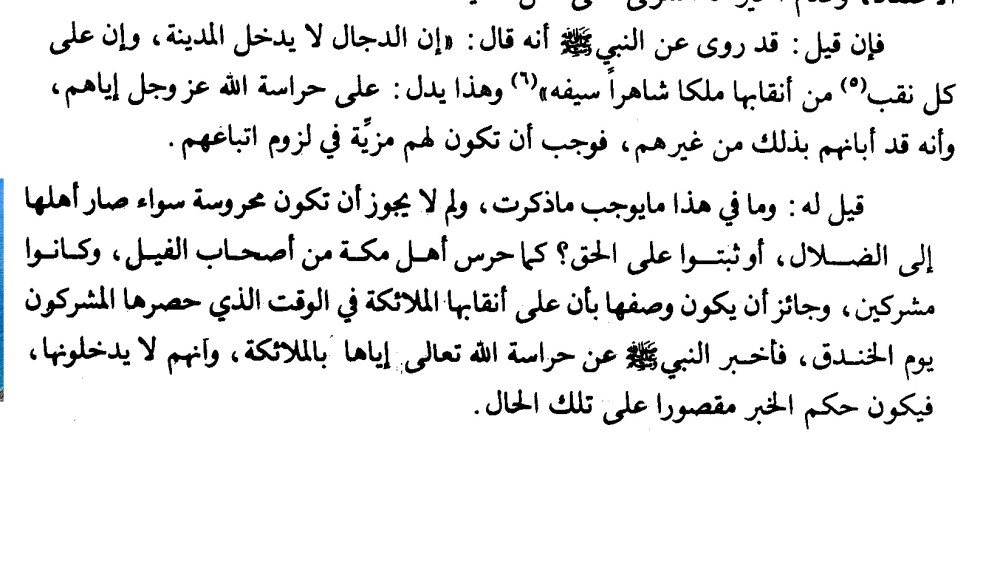
In this paragraph, Al-Jassas is responding to the Maliki position, who believe that Ijma’ (consensus of the scholars) is only valid if it has been established by the Scholars of Medina. They authenticate their position with a hadith, which says, “The Dajjal (The Anti-Christ) cannot enter Medina because it is guarded by appointed angels holding swords.” Therefore, according to them, this hadith verifies that God has protected them (the people of Medina) and distinguished them from the remaining Muslims. Thus, this demonstrates that they are superior and that the remainder of the Muslims should follow them.
Thereafter, Al-Jassas responded (in the second paragraph) to this statement of the Maliki scholars and gave two interpretations to the above-mentioned hadith of The Dajjal. Al-Jassas said;
“This hadith does not necessarily mean what you have said! Why is it impossible for Medina to remain protected regardless of whether the inhabitants become misguided or remain on the truth? The similitude of this event was when God protected the inhabitants of Mecca from the “Ashab-e-Fil,” (the People of the Elephant) even though they (Meccans) were pagans. Furthermore, it is possible that the Prophet Muhammad (PBUH) has stated that the angels protect the passages of Medina when the pagans surrounded it during the ‘Battle of the Trench’ (Ghazwa al Khandaq). Therefore, the Prophet Muhammad (PBUH) said that God has protected it by angels, and that the pagans cannot enter.”
Consequently, this hadith will refer to that specific situation.
(To summarise the above text)
Maliki’s believe that the only acceptable and valid ijma is of the ‘Ahle Medina’ (People of Medina) and they substantiate this statement with the hadith of The Dajjal.
Al-Jassas refutes the Maliki position. He adds that one cannot use this hadith to validate their position as the hadith has two potential interpretations:
- God will protect Medina as He protects Mecca, regardless of whether the inhabitants are guided or misguided.
- The hadith of The Dajjal is referring to the Battle of the Trench incident, which took place during the lifetime of the Prophet Muhammad (PBUH).
Some of the Ulamaa thought that Jassas is splitting the hadith into two parts and further accepting one part and denying the second. I have no idea why they had this thought and on what basis they came to this conclusion. I hope these Ulamaa can explain what made them understand the text that way. Here are the two parts of the hadith;
- The Dajjal does not enter Medina
- Angels protecting Medina.
According to that, Al-Jassas has accepted the second part only but not the first part of the same hadith. That means that Al-Jassas is saying that Dajjal was not with the army of the pagans during the Battle of the Trench but Medina was protected by angels. I would say that is quite an unusual way of understanding this point. I think this understanding is incorrect because;
- The text of Al-Jassas is very clear. He has mentioned the whole text of the hadith and given two possible interpretations.
- We should not make Al-Jassas say something which he did not. I want to ask the reader to once more, read what Al-Jassas said in order to see he is not splitting the same hadith into two parts.
- Al-Jassas referred to the entire hadith of the Dajjal. Al-Jassas has explicitly confirmed it too, when he said; Consequently, this hadith will refer to that specific situation.
- According to the second interpretation, Al-Jassas said, “This hadith, which speaks about the angels restricting Dajjal from entering Medina, occurred during the Battle of the Trench!”
- However, if we take the other interpretation (which claims that Al-Jassas has split the same hadith into two parts) then the meaning will be understood as follows:
Al-Jassas said, “The Dajjal is not mentioned within the hadith but the hadith is speaking about angels protecting Medina physically and not spiritually. Thus, I (Al-Jassas) agree with the Prophet Muhammad (PBUH) regarding the angels protecting Medina during the Battle of the Trench, but I disagree with the Prophet Muhammad (PBUH) saying that the Dajjal was within the army of the pagans!”
I assume, no one would think that Al-Jassas mentions the whole hadith, then accepts only part of it and rejects the second half. The scholars on his rank do not do that because God said;

So do you believe in part of the Scripture and disbelieve in part? Then what is the recompense for those who do that among you except disgrace in worldly life; and on the Day of Resurrection they will be sent back to the severest of punishment. And Allah is not unaware of what you do. 2;85
Now it is very clear that Al-Jassas did not reject the part of the hadith which he mentioned, rather he accepted it as whole but gave two possible interpretations.
The Second Text of Al-Jassas
Let us read the second part of Al-Jassas’ text:
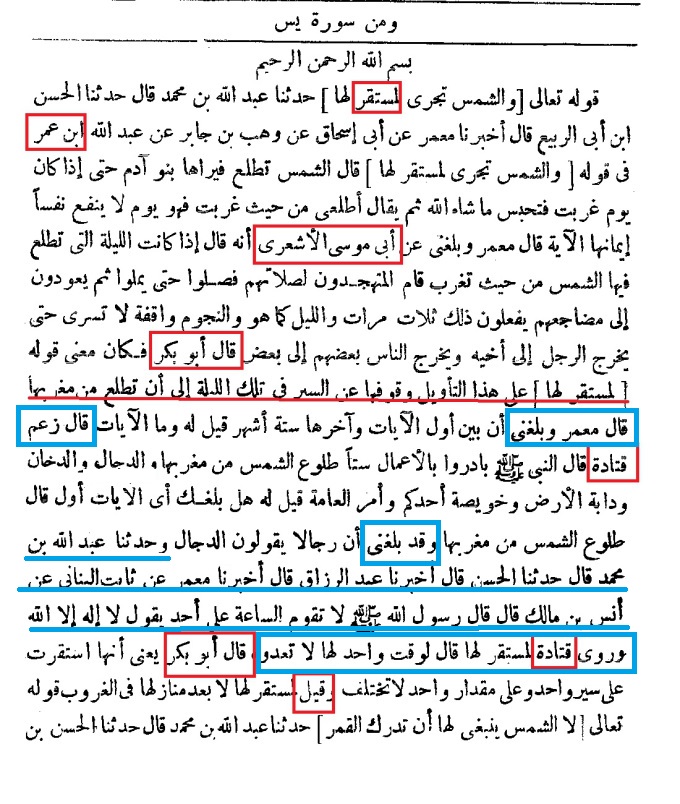
Some of the scholars, by reading the above, thought Al-Jassas most likely believed Dajjal did not yet arrive and will come towards the Last Day and he is confirming his belief in this page of his book.
Let’s read and analyse the text together. Al-Jassas was talking about the meaning of ”Mustaqarr.”

And the sun runs [on course] toward its stopping point. That is the determination of the Exalted in Might, the Knowing. 36;38
Subsequently, what does ”Mustaqarr” mean?
Al-Jassas quoted the opinions of several scholars, in regards to the meaning of Mustaqarr:
- Second red box- Ibn Umar’s opinion states: The sun rises, so people will see until the day the sun sets and it will be kept as long as God wills. Then it (the sun) will be ordered to rise again. It is that day when the good deeds of the people will not benefit them.
- Third red box- Abu Musa Al-Ash’ari; The night when the sun rises from the west, the people will pray Tahajjud until they will be bored and they will go back to their beds. They will repeat this three times, but the night will remain as it is and the stars will remain stationary. Then people will go out to meet each other…
- Fourth red box. Al-Jassas extracted the meaning of ”Mustaqarr’‘ based on the above two opinions and said, “Based on this interpretation, ”Mustaqarr” means stopping from a motion and staying still…”
- Under the red line; Ma’mar said; Balaghani (I have been told) that between the first and the last signs are six months. Someone asked him, “What are the signs?” He said, “Qatada made Za’m (claim) that the Prophet Muhammad (PBUH) said; “Hurry up, in performing good deeds before six things; the sun rising from the west, the appearance of the Dajjal, (spreading of) the Smoke, (the appearance of) the Beast, Khuwaisah (a very personal matter) of each of you, and a public thing.” Someone asked him (Qatada); “Have you been told what is the first sign?” He said; “Balaghani (I have been told) the sun will rise from the west. Also, Balaghani (I have also been told) that some people say that it is the Dajjal. [Further, Al-Jassas narrates the hadith] from Hazrat Anas (RA) who narrates it from the Prophet Muhammad (PBUH) “The last day will not occur on anyone who says ”La Ilaha Illallah!” [I will comment on this later].
- Third red box from the bottom; Qatada said; in one waqt without changing it.
- Second from the bottom, Al-Jassas explained the above statement; that “The sun will be following the same type of motion on the same duration without changing.”
- Last red box; Qeela [means ”some said”, which denotes a weak opinion]; “Not after it is stationary, but after it sets.”
Al-Jassas mentioned Dajjal in the fourth point. Obviously, Al-Jassas, as a high level Faqih (jurist) and Muhaddith (expert of hadith) speaks in his own language. I have highlighted the words which are most important to be understood, in order to understand the technical language Al-Jassas is using.
From this, we comprehend that the text is obvious; Al-Jassas was quoting the meaning of ”Mustaqarr” from several scholars and explaining what it means. The technical words which he used are; Balâghah, Za’m.
Balâghah
In the Mustalah (science) of Hadith, we have a very important chapter titled ‘’Way of Transmitting’’, which, as the name suggests, discusses how to correctly transmit the hadith. There are many terms used by narrators to transmit the hadith, but not all of them are used in random places. For instance, if you hear the hadith from your Sheikh on your own, then you have to use the term of ‘’Haddathani’’ which means ‘’He told me’’. However, if you hear it from the Sheikh in a group of students, then you have to use ‘’Haddathana’’ which means ‘’He told us’’. Further, we have many other terms used to transmit such as ‘’Anba’ana, Akhbarana, Unbi’tu, Nawalani, Rasalani, Dhakarani, ‘An, Qala, Qeela, Dhakara, Dhukira’’ etc… Also, we have another term which is ‘’Balaghani’’. It is a term used for one very specific way of transmitting. Let’s say you find a copy of a collection of Hadith. There are two options:
- You know the author of the copy because you recognise his hand-writing.
- You do not know who has written the copy, regardless if you know the book, for example Sahih Bukhari, or you do not know what is in this book.
In the first scenario you have to say while narrating ‘’Wajadtu bi Khatti Fulan’’, and for the second one you have to say ‘’Balaghani’’.
Here are the proofs;
Imam Sakhawi (d. 1497 AD) confirms that ‘’Balâghah’’ is used if you find a copy of a book and you do not know who the author is.
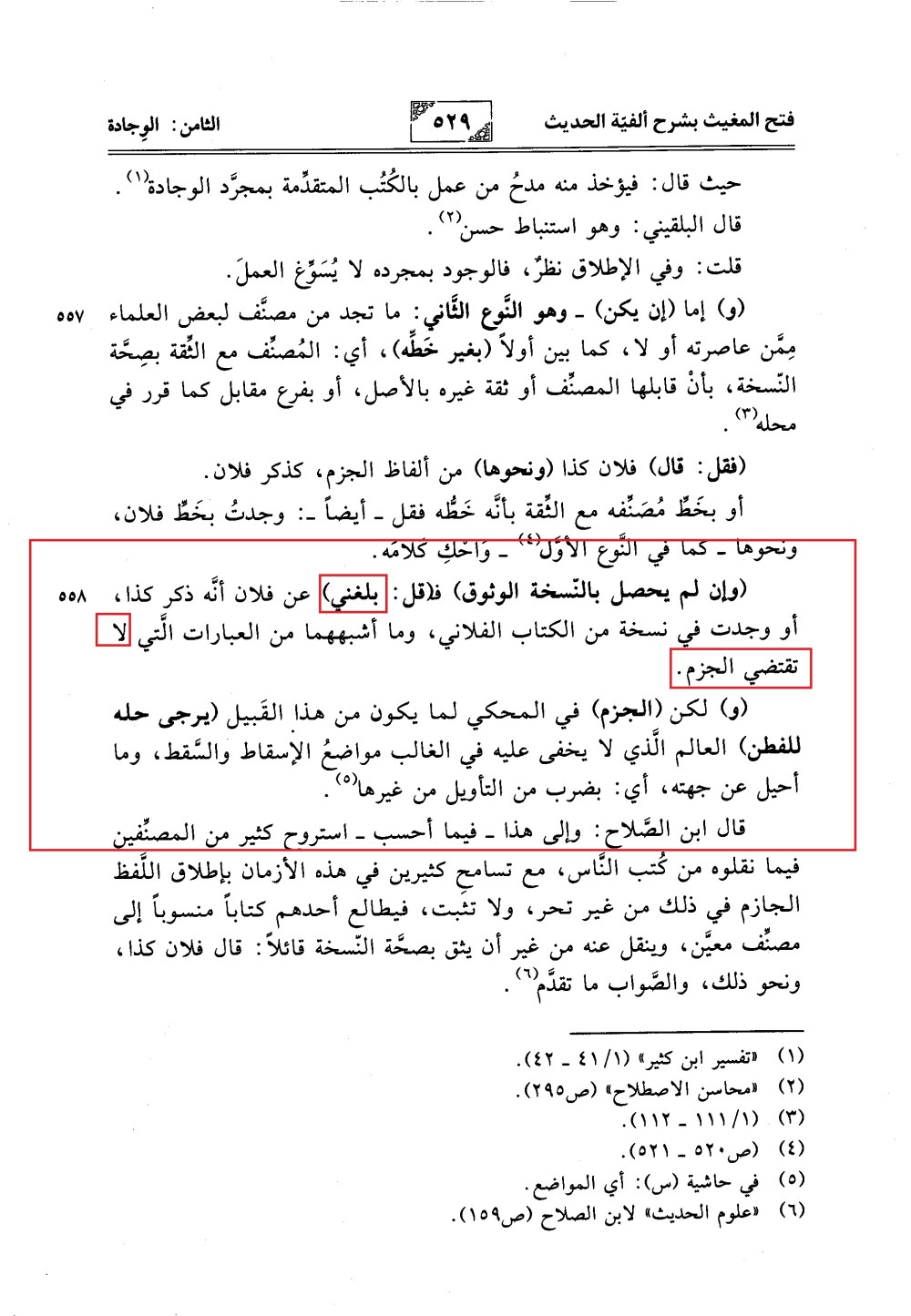
Note that he is explicitly confirming that you have to use ‘’Balâghah’’ or some other term of Wijadah which confirms that it is NOT A MATTER OF CERTAINTY!
Here is Imam Suyuti (d. 1505 AD) also confirming that ‘’Balâghah’’ is used in the case of Wijadah if you do not know who the copy is written by. Also, you are not allowed to use any term which gives a certainty such as ‘’Haddatha, Akhbara, Qala’’ etc…
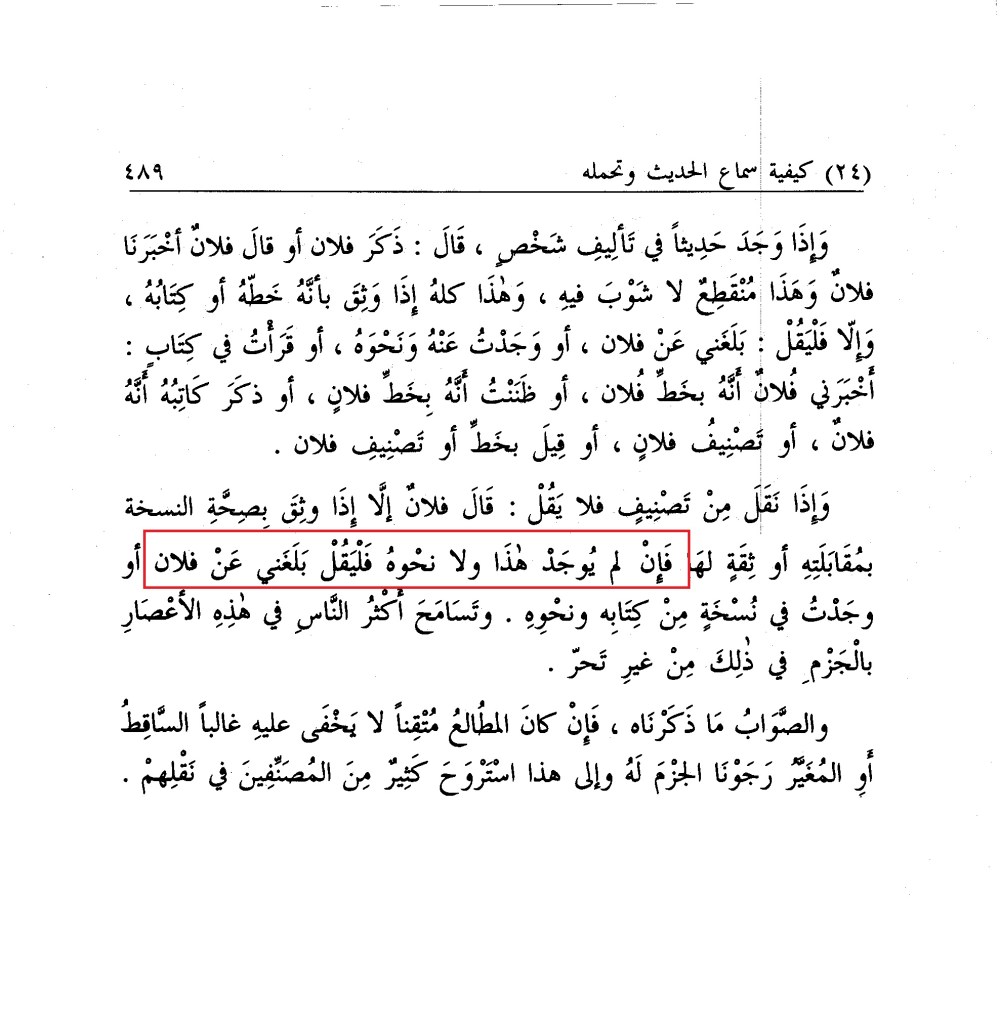
Now we can understand exactly what Ma’mar is doing and what Jassas is doing in turn.
So, Ma’mar is saying ‘’I found a copy of a book but I do not know who has written it’’. And therein, are the six signs of the Last Day.
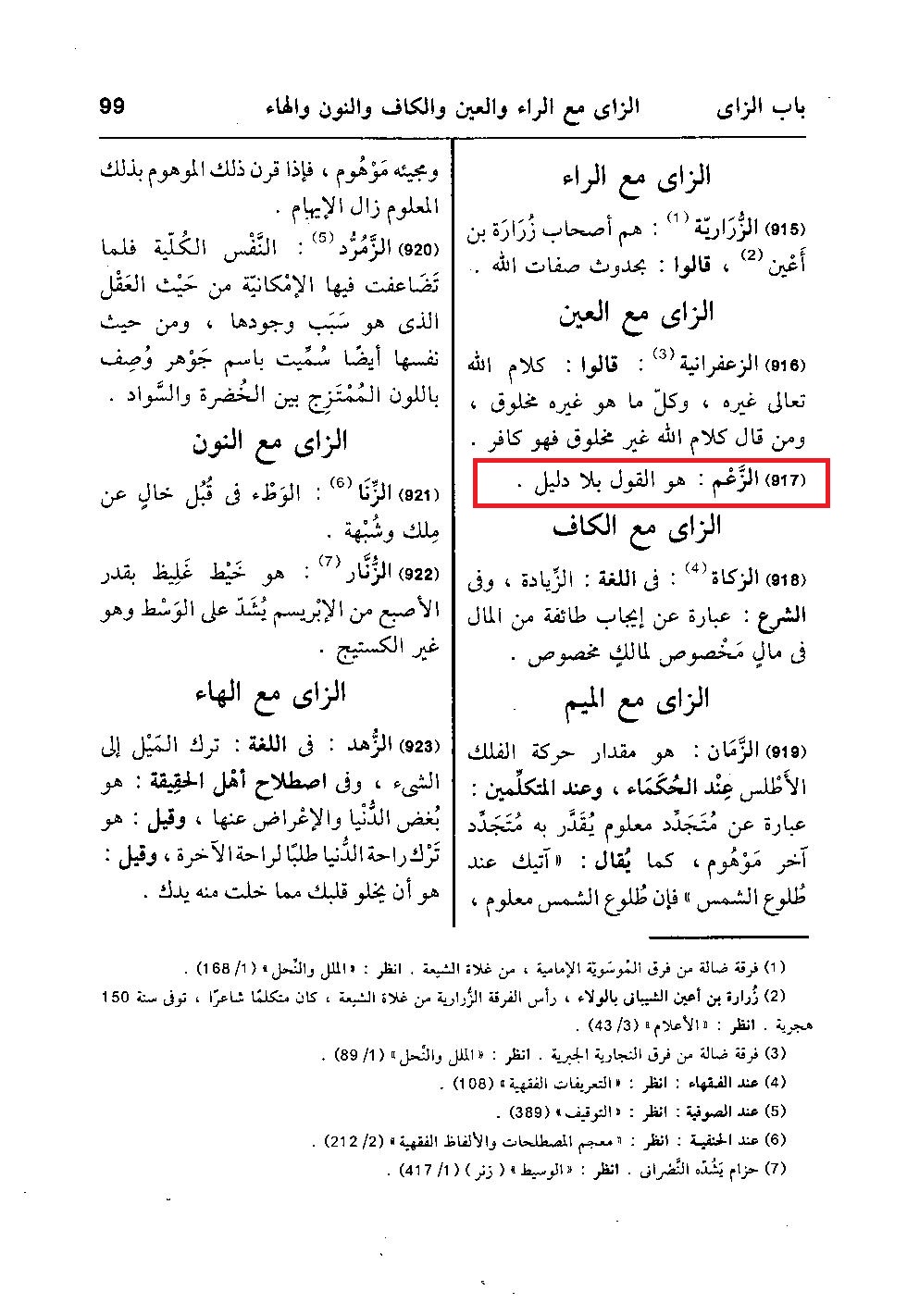
Za’ama
Thereafter, the terms used by Al-Jassas is (Za’ama) “claiming without proof” that which is meant to be from the Prophet (PBUH). Here is Jurjani (d. 1414 AD) explaining the meaning of Za’m.
Interpretation of the Text
Now, let’s translate what Al-Jassas said in the fourth point;
Ma’mar said; ”I found in a book of an unknown author that the time period between the first and the last signs [of Last Day] is six months.”
Someone asked him; ”What are these six signs?”
Ma’mar said; ”Qatadah made a claim without giving any proof that the Prophet PBUH said; Hurry with the good deeds before six things; the sun rising from the west, Dajjal, the smoke, the animal, Khuwaisa and Aammah!”
Someone asked; ”Do you know which sign appears first?”
Ma’mar said; ”The sun rising from the west. Also, I read in a book of unknown authorship that some people say that the first sign to appear is Dajjal.”
In this short text, Al-Jassas demonstrated that Ma’mar made two weak points, then Al-Jassas has clarified the issue by stating the authentic position by the hadeeth which he has transmitted. Below the two weak points of Ma’mar:
- By using the term of ‘’Balagha’’ he mentioned indirectly that the Last day will occur on the people who have a habit of praying a Tahajjud (night prayer).
- Attributed the above point to Qatadah by using the term of ‘’Za’ama’’.
Clarification of Al-Jassas to clarify these two points:
- Al-Jassas narrates the hadith that “The Last Day will not occur as long as there is one believer”. Then he mentioned another statement from Qatada, which opposes the previous statement from the same Qatada. Most importantly, the second statement of Qatada is mentioned by Al-Jassas in a strong form by using the word ”Rawa‘.
- Presented an authentic narration which shows the real opinion of Qatadah about the meaning of ‘’Mustaqarr’’. As we see, Al-Jassas has narrated this opinion by ‘’Qala’’ used in the authentic way!
Conclusion
- Now we understand that Al-Jassas did not deny that Dajjal did not arrive during the life time of the Prophet PBUH, but actually suggested that one of two correct interpretations of the hadith about ‘the Dajjal not entering Medina‘ is that he was blocked from Medina in the Battle of the Trench.
On the other hand, according to the misinterpretation; Al-Jassas suggested to split one hadith into two parts, thereafter rejecting the first part and accepting the second.
2. In the second text, Al-Jassas quoted several interpretations from the scholars concerning the word ”Mustaqarr”. Whilst mentioning the opinions, he quoted two statements from Qatada; one he quotes with a weakness [Za’ama] and the second quoted as strong [Rawa].
Nonetheless, I am not claiming that the Dajjal does not exist, or Al-Jassas does not believe in him, as he has already confirmed the hadith of the Dajjal. Rather, he gives an interpretation to the hadith, which is not common and says that Dajjal has already arrived in the time of the Prophet PBUH. Furthermore, I have not come across or seen any Hanafi scholars rejecting the notion of the Dajjal. I personally do not reject it either; however, I may disagree with some in these three main points:
- There is not only one Dajjal, but there are many of them.
- There are numerous incorrect understandings regarding what or who the Dajjal is.
- According to some, he can do certain things, which in actuality I believe to be impossible, based on the Maturidi school I follow.
Once again, I want to present my apology to the scholars for posting a text without detailed explanation of what it was I was presenting. I will make sure that the next time any text I post will be translated and explained so that our ulamaa can better understand it.
God Bless.
 Shaykh Atabek Shukurov an Nasafi
The more I read about this Imām, the more I’m in love with him!
Yā Fa’s al-Ahnāf, I have some more questions about Imām al-Jassās: he lived around the same time as Imām al-Māturīdī, so why was he not a part of his school? Is it because of his location (in Baghdād, far from Samarqand)? I doubt it, rather I imagine a mujtahid of his stature would have still held his Mu`tazilī positions. But did he ever interact with any mutakallims from Mā Warā’ an-Nahr?
Is there a sign of perhaps some compromise from Imām al-Māturīdī’s side on the issue of the Beatific Vision, when he writes about the permissibility of interpreting nażr as intiżār? Might there have been other such compromises, such as in the issue of Khalq ul-Qur’ān – and did al-Jassās even accord the Mu`tazilah on that issue (as I have begun to myself)?
Also, dear Shaykh, could you please let me know if you received that .pdf I sent to your e-mail a while back?
I also still haven’t been able to find anything out about the isse of Imām Abū Hanīfah and qabd/sadl, so I’d greatly appreciate some guidance from you on that.
JazakAllāh khayr!
-Rasheed
LikeLike
I’m also puzzled as to why we have Jassās’s fiqh and usūl, but not much of his kalām, while we have Māturīdī’s kalām, but not much of his fiqh and usūl 🤔
LikeLike
Could you please comment on which Dajjal was meant in the following statement of the Aqida Tahawiyya? I look forward to reading your next article on this topic!
“We believe in the signs of the Hour such as the appearance of the Dajjal and the descent of `Isa ibn Maryam, peace be upon him, from heaven and we believe in the rising of the sun from where it sets and in the emergence of the Beast from the earth.”
LikeLike